What's New - February 2003
[Home]
February 26, 2003: Two avid "Logic puzzlers" have been been giving my "Logic Problem Solver" program a workout for the past few weeks. The result is a a new version posted yesterday with a number of bugs fixed and a few significant enhancements. If you're into that sort of thing, check out this new version.
February 21, 2003:

I had added the ability to display date/ time messages in our Scrolling LEDs program a couple of months ago, but never got around to posting the change. This week a user requested the ability to display scrolling LED messages in a separate window, so I decided it was time to post this version incorporating both changes.
 February
15, 2003: One of the kids got me a binary clock for
Christmas. It seems pretty cool, and I am even getting
pretty good at reading it. So here's a software
version of the Binary Clock with
some features that the hardware version can't match - it's easier
to set, LEDs (and background and labels) can be any color you
want, and you can set a "secret" time to test student's
ability to convert a binary time to decimal without getting a hint
from the clock on the wall! .
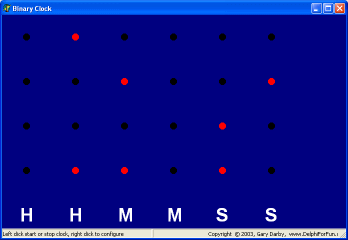
February
15, 2003: One of the kids got me a binary clock for
Christmas. It seems pretty cool, and I am even getting
pretty good at reading it. So here's a software
version of the Binary Clock with
some features that the hardware version can't match - it's easier
to set, LEDs (and background and labels) can be any color you
want, and you can set a "secret" time to test student's
ability to convert a binary time to decimal without getting a hint
from the clock on the wall! .
 February
9, 2003: I've had an interesting exchange in the past
week or so with a college professor who is trying to decode the
names and phrases used by the Lilliputians in Jonathan Swift's
book "Gulliver's Travels". He was
looking for a version of our Decrypt program which would
relax the dictionary matching requirements. I had thought
previously about allowing one or more unmatched words (words not
in the dictionary) when decrypting. Unfortunately, my
current approach starts by decrypting the longest word in the
message first on the assumption that there will be the fewest
possible decryptions of this word and thus will prune the
search quickly. If we assume that the longest word does have
to be in the dictionary however, search time explodes!
So it's back to the drawing board on that project. To make a
long story short(er), I switched to an anagram approach and
modified the Unscramble program to read a text file of
names and phrases and produce a text file of possible
anagrams. Whether it will help or not remains to be seen,
there are phrases containing words like
"king" and "elfin" .
February
9, 2003: I've had an interesting exchange in the past
week or so with a college professor who is trying to decode the
names and phrases used by the Lilliputians in Jonathan Swift's
book "Gulliver's Travels". He was
looking for a version of our Decrypt program which would
relax the dictionary matching requirements. I had thought
previously about allowing one or more unmatched words (words not
in the dictionary) when decrypting. Unfortunately, my
current approach starts by decrypting the longest word in the
message first on the assumption that there will be the fewest
possible decryptions of this word and thus will prune the
search quickly. If we assume that the longest word does have
to be in the dictionary however, search time explodes!
So it's back to the drawing board on that project. To make a
long story short(er), I switched to an anagram approach and
modified the Unscramble program to read a text file of
names and phrases and produce a text file of possible
anagrams. Whether it will help or not remains to be seen,
there are phrases containing words like
"king" and "elfin" .
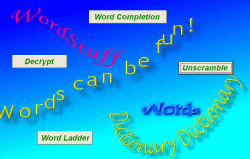
Anyway, while doing all of this, I decided to re-post the WordStuff #2 program with some minor cosmetic issues corrected. Wordstuff #2 is a "wrapper" for four other programs: Decrypt, Unscramble, Word Completion (Crossword Helper), and Word Ladder. So if you haven't tried it before, take a look!
February 5, 2003: While searching for sample code to identify running programs yesterday, I ran across this CPUSpeed program. As the name implies, run it and it tells you the speed of your CPU. Of course you probably know the speed of your processor, but some laptops automatically "underclock" and speed demons regularly overclock so there may be a purpose - besides being a simple bit of code that might get you as close to the hardware internals as you'll ever want to be
February 4, 2003: It seems like I'm involved with a number of not-so-fun projects these days. So I took today to work on one that is going to be fun: an X-10 monitor and control application. X-10, if you are not familiar with it, uses house wiring to transmit control signals to and from devices. There is a two-way computer interface available which opens up possibilities for detecting movement and device usage and issuing commands to turn on lights, make announcements, sound alarms, etc. When a vehicle triggers our driveway alarm, the computer now announces "Someone is coming , run and hide!" There's still a ways to go, but the project did prompt today's posting EnumWindows in the Delphi Techniques section. The monitor program must converse with a terminal program which accepts and sends signals over a serial port. In order for the monitor program to start and stop the terminal program gracefully, it must be able to detect if the program is running. This program will accomplish that. One small step ....